
Chengxiang Heavy Industry vertical crusher is designed for processing raw materials used in organic and compound fertilizers. It transforms compost, livestock manure, fertilizer clumps, and mineral materials into uniform granules. With high crushing efficiency and low energy consumption, it is an ideal choice for fertilizer production lines.
Fertilizer caking, the accumulation of oversized particles, and the handling of moderately moist raw materials are common daily challenges in fertilizer production. The Chengxiang vertical crusher addresses these issues through a simple, effective design: it features no screens and no bottom grates. Materials are pulverized by high-speed impact within a vertical chamber and then fall directly through. Consequently, there are no components to become clogged by moisture or damaged by friction-induced heat.
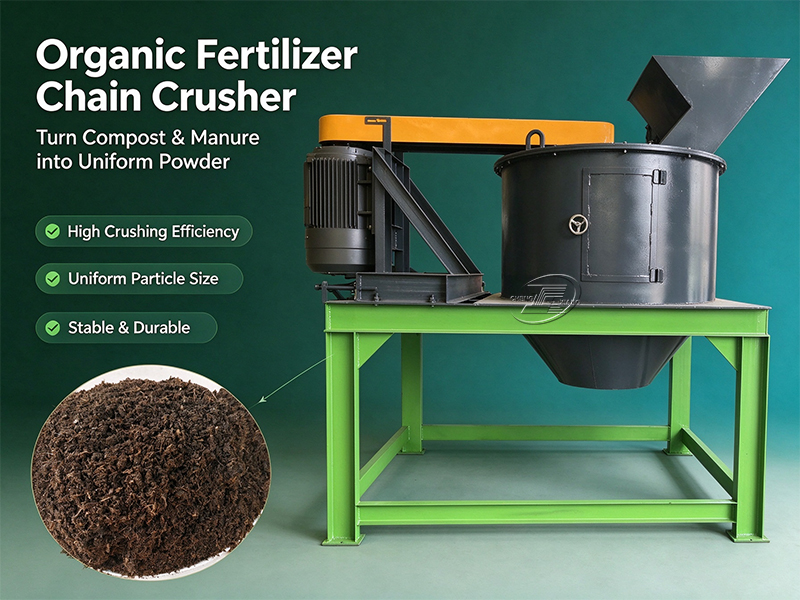
Why choose a vertical crusher?
1. No screens or grates—eliminates clogging
Traditional crushers often fail when processing moist materials because their screens become blocked. The vertical crusher’s open-bottom discharge allows materials with moisture content as high as 25% to pass through continuously, significantly reducing downtime.
2. Precise crushing, avoiding over-pulverization
The impact-and-fall mechanism breaks clumps down to the desired size, allowing fine particles to pass through immediately rather than being ground into dust.
3. Ideal for recycling oversized materials
In compound fertilizer production, oversized particles rejected during the screening stage can be fed back into the vertical crusher for reprocessing, closing the production loop and minimizing raw material waste.
4. Compact vertical footprint
Its vertical design occupies less floor space than horizontal crushers of equivalent capacity, making it easy to integrate beneath existing screening towers or between conveyors.
5. Corrosion-resistant and wear-resistant internal components
The chamber linings and hammers/chains are constructed from wear-resistant alloys. For corrosive fertilizer salts, contact surfaces are specially treated to extend their service life.
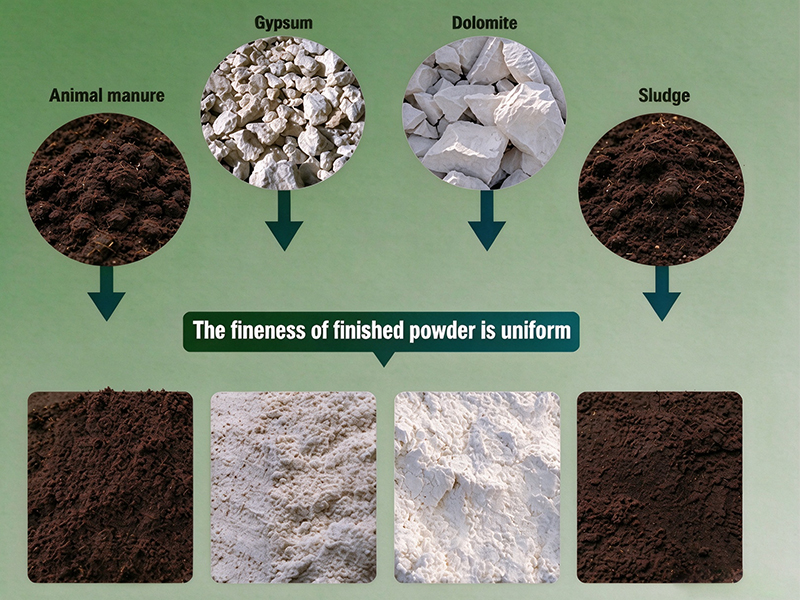
How does a fertilizer crusher work?
1. Material enters the vertical crushing chamber through an inlet at the top.
2. A high-speed main shaft equipped with hammers (or chains) strikes the material against the surrounding liner plates.
3. The crushed particles fall through an open bottom under the force of gravity, encountering no resistance from screens.
4. The discharge outlet connects directly to a belt conveyor or the next stage of the process, as the material is discharged via gravity. Throughput remains stable even if the moisture content of the material fluctuates throughout the day.
Applications for Fertilizer Crushers
Compound fertilizer (NPK) plants: Crushing caked urea, diammonium phosphate (DAP), potassium chloride, and oversized recycled granules. Organic fertilizer plants: Breaking up clumps of fermented material prior to granulation.
Chemical industry: Processing salts, additives, and moderately moist chemical lumps.
Construction materials and mining: Handling gypsum, coal gangue, and medium-hardness limestone chunks.
3 Types of Organic Fertilizer Crushers to Choose From
Vertical Crusher, Chain Crusher, and Semi-Wet Material Crusher—which one do you need?
1.Chain Crusher: Recommended for dry to slightly moist fertilizer lumps and caked NPK fertilizer.
2.Vertical Crusher: Ideal for materials with medium moisture content and for reprocessing oversized particles; features a compact footprint.
3.Semi-Wet Material Crusher: Designed for organic materials with high moisture content (25%–50%), such as fertilizers and compost.
Not sure which one you need? Simply email us the type of material you are processing and its moisture content, and we will be happy to provide a professional recommendation.
Why choose a fertilizer crusher from Zhengzhou Chengxiang Heavy Industry?
As a manufacturer of complete fertilizer production lines, we design our vertical crushers to integrate seamlessly into the entire production process—ensuring that inlet height, capacity, and control systems are perfectly matched with your other equipment. We offer direct-from-factory pricing, provide original spare parts and engineering drawings, and possess extensive export experience, including specialized sea-freight packaging and documentation for global delivery.
Questions about fertilizer crushers?
Q: What is the maximum moisture content this machine can handle?
A: Based on our experience, the limit is approximately 25%. For wetter organic materials (such as manure or compost with 25%–50% moisture), our crusher designed for semi-wet materials is the appropriate choice—we will guide you toward the right machine based on your specific data.
Q: Does an open-bottom design mean the particle size cannot be controlled?
A: The fineness of the output is controlled by the rotor speed and the gap between the hammers and the liners, typically resulting in a particle size of 2–4 mm. If you require a guaranteed maximum particle size, please provide your specifications, and we will confirm the results achievable with your material.
Q: How often do wear parts need to be replaced?
A: Hammers and liners are consumables; their lifespan depends on the abrasiveness of the material. Both can be replaced by unbolting and swapping in new parts—replacement components are shipped along with the machine.
Q: Can it operate continuously, all day long?
A: Yes, it is designed for continuous operation within its rated capacity. We recommend performing routine inspections of wear parts as outlined in the manual.


