
Advantages of the Zhengzhou Chengxiang Heavy Industry Disc Granulator:
85%–95% granulation efficiency—a high-yield, cost-effective solution for wet granulation.
Uniform spherical granules (1–6 mm)—features an integrated automatic classification function to ensure all output meets specified size requirements.
Steplessly adjustable disc inclination (45°–55°) and rotational speed (10–30 rpm)—allows for rapid adjustments, making it suitable for NPK (nitrogen, phosphorus, and potassium) fertilizers, organic fertilizers, and humic acid-based formulations.
Open-disc design—enables clear, real-time visual monitoring and facilitates quick transitions between different formulations.
Optional stainless steel construction—corrosion-resistant design, ideal for organic fertilizer and chemical production applications.
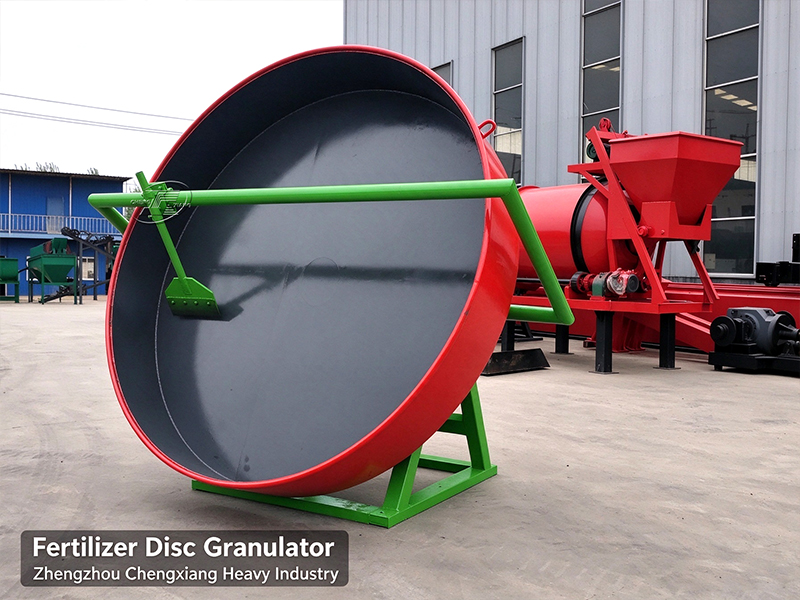
Working Principle of the Disc Granulator: A Three-Stage Process Analysis
Working Principle of the Disc Granulator by Zhengzhou Chengxiang Heavy Industry: Wet Agglomeration
The disc granulator (disc-type granulation equipment) from Zhengzhou Chengxiang Heavy Industry utilizes a wet agglomeration process to transform fine powders into spherical granules ranging from 1 to 6 mm in diameter. It is suitable for the production of NPK fertilizers, humic acid-based fertilizers, and various other organic, inorganic, and blended fertilizers.
1. Granule Formation: Dry powder comes into contact with a metered amount of liquid binder on an inclined, rotating disc. Through continuous adhesion, the material begins to form dense granules.
2. Layered Growth: Driven by centrifugal force and gravity, the granules tumble amidst the dry material, growing larger through a process of successive layering—much like the layers of an onion. This enhances the compressive strength of the granules and ensures a uniform distribution of nutrients.
3. Automatic Classification: By leveraging the tilt angle of the disc (45°–55°) and the frictional resistance between the materials, the system automatically classifies particles by size. Granules measuring 1–6 mm spill over the edge of the disc, while finer particles remain inside to undergo further granulation.
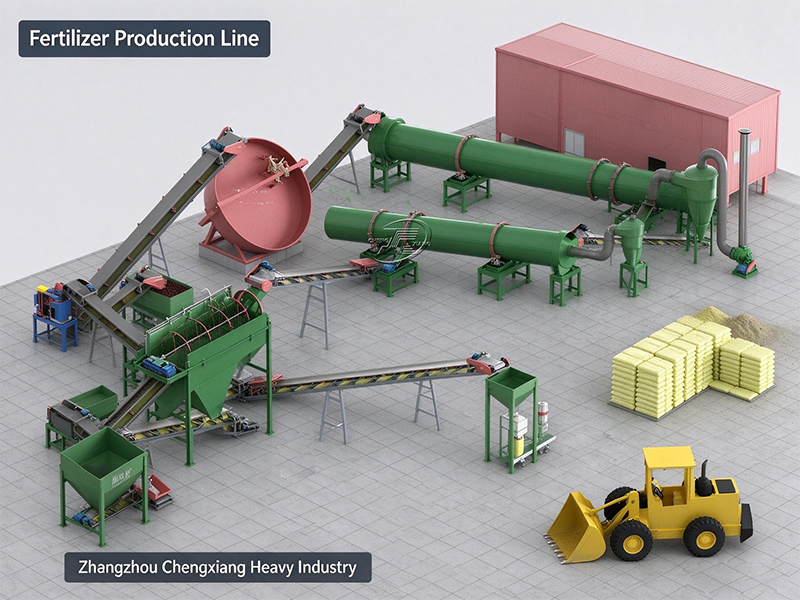
Phase 1: From Raw Material to Granules—The Starting Point
This is where every granule begins its life. Dry powder is fed at a controlled, continuous rate into an inclined, rotating disc. Simultaneously, a precisely measured liquid binder—typically water or a specialized solution—is introduced via a spray system.
Granulation Principle: Driven by capillary forces, the wetted fine particles adhere to one another, forming dense, microscopic granules.
Industrial Detail: The Importance of Atomization. How the liquid interacts with the powder is the key to success. The binder must be atomized into micron-sized droplets and distributed uniformly. If the liquid is introduced as a coarse stream or jet, it can cause localized over-wetting, leading to the formation of mud clumps or causing material to stick to the walls of the disc. In contrast, uniform atomization ensures that the surface of every particle is coated with an ultra-thin liquid film. This prevents unwanted clumping from the outset and ensures consistent particle sizing. The quality achieved at this stage directly determines the uniformity and yield of the final product. The disc granulator from Zhengzhou Chengxiang Heavy Industry features a customizable atomization spray system, which can be precisely tailored to your specific raw materials.
Phase 2: Layered Growth—Building Strength and Uniformity
Once formed, the granules do not remain stationary; instead, driven by the unique motion of the disc, they enter a continuous “granulation” process.
The Mechanics of Motion: The rotation of the disc generates centrifugal and frictional forces, which carry the granules upward. Subsequently, the inclination of the disc allows gravity to pull them back down. This constant cycle of rising and falling serves as the driving force that causes the granules to collide, tumble, and grow.
“Onion-Skin” Layering: As the granules tumble, they collide with and capture additional dry powder. This material accumulates on the surface of the granules, layer by layer—much like the layers of an onion. However, this is not merely a loose accumulation of material. The impact and frictional forces generated during the rolling process compact the moisture and fine particles within the layers, while simultaneously expelling trapped air—a mechanism that continuously enhances both the strength and density of the granules.
Controlling Granule Uniformity: By adjusting the rotational speed of the disc, operators can precisely regulate the balance between the “rolling” motion and the “cascading” (or waterfall-like) descent of the material. Higher rotational speeds carry the material further up the disc before it falls, thereby intensifying the impact-compaction effect. The resulting granules exhibit higher density, superior sphericity, and excellent uniformity.
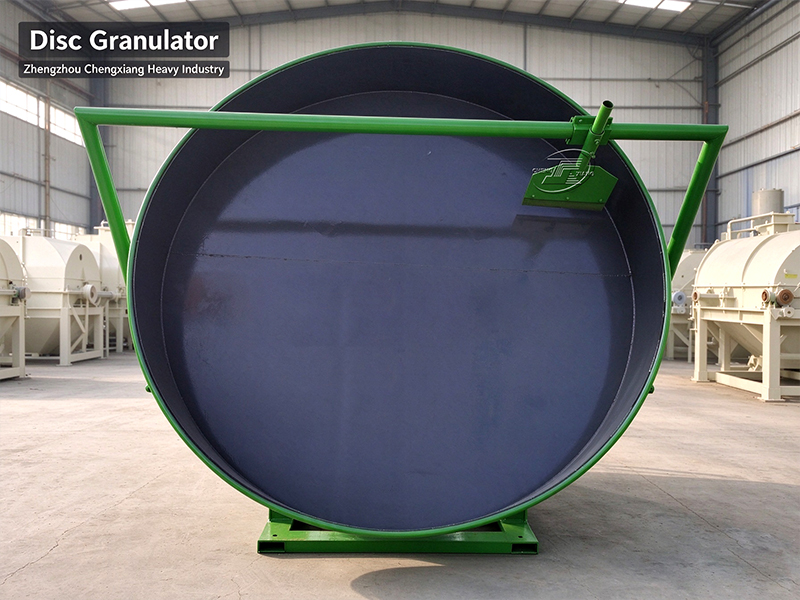
Phase 3: Automatic Classification
This is a sophisticated feature of the disc granulator: it achieves size-based separation without the need for any external screening equipment.
Separation Principle: When a mixture of granules of varying sizes is subjected to vibration or rotation, smaller particles migrate downward through the gaps between larger ones, effectively pushing the larger particles toward the surface.
Precise Discharge: With the disc typically set at an inclination angle of 45°–55°, frictional forces drive the larger granules (1–6 mm) on the surface to move upward along the edge of the disc. Upon reaching the rim, they spill over continuously as the finished product. Meanwhile, finer powders and smaller, still-growing granules gravitate toward the bottom of the disc, where they remain part of the ongoing granulation cycle. This built-in, automatic classification mechanism ensures a high degree of size uniformity in the discharged granules.
These three stages operate in a state of precise dynamic equilibrium. It is this mechanism that enables the disc granulator to efficiently and consistently transform fine powders into uniform, spherical granules. This process is ideally suited for applications that demand high sphericity and operational flexibility.
Looking for a tailored granulation solution? Consult with Zhengzhou Chengxiang Heavy Industry—a professional manufacturer of fertilizer equipment—to obtain a customized system designed specifically for your materials.
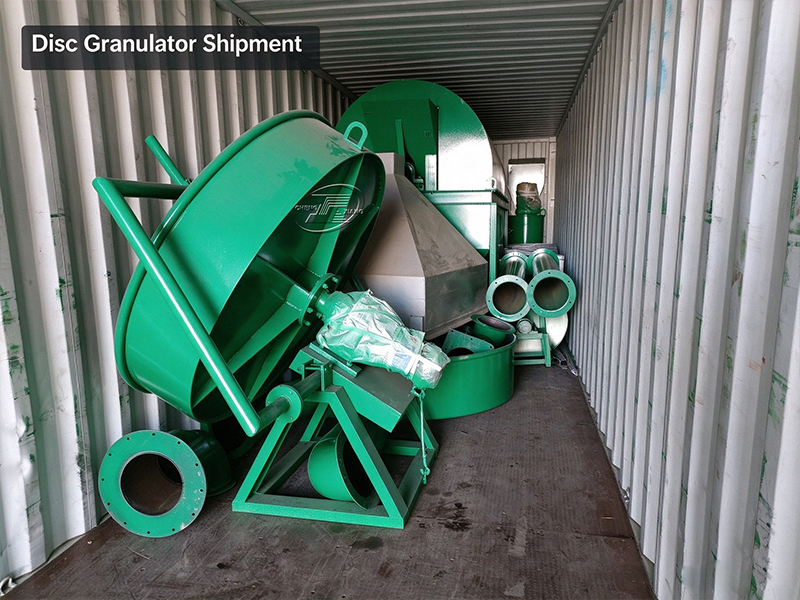
Zhengzhou Chengxiang Heavy Industry – Professional Fertilizer Equipment Manufacturer
Zhengzhou Chengxiang Heavy Industry is a well-known supplier of disc granulators and other fertilizer equipment in China. We are committed to producing professional, high-quality, and efficient fertilizer equipment. We utilize advanced technology and design to manufacture fertilizer granulators and fertilizer production lines, and can add other equipment or provide customized designs to meet your needs. At Zhengzhou Chengxiang Heavy Industry, you are sure to find your ideal fertilizer equipment. Furthermore, if you encounter any problems or have any needs during production using our fertilizer equipment, we provide 24-hour assistance.
Zhengzhou Chengxiang Heavy Industry mainly supplies: organic fertilizer production lines, compound fertilizer production lines, BB fertilizer production lines and supporting equipment. We design and provide a complete production line for you. Please rest assured that as a fertilizer equipment manufacturer with 30 years of export experience, we have the ability and confidence to satisfy you with our products. Welcome to visit our factory and purchase equipment.


